
English| EUR
Suggested for you
More currencies
Choose a language
Provincetown sits at the northern tip of Cape Cod, closer to Stellwagen Bank National Marine Sanctuary than any other port on the Eastern Seaboard. That proximity matters: less transit time means more observation time over one of the Atlantic's richest feeding grounds. Choosing among the town's whale-watching operators comes down to vessel size, naturalist quality, and how each company handles the inevitable variability of marine wildlife.
Quick answer
Provincetown whale watching reviews consistently highlight shorter travel times to Stellwagen Bank—typically twenty to thirty minutes—and high sighting rates during the April through October feeding season. Guest feedback centers on naturalist expertise, vessel comfort, and whether the crew respects marine mammal approach guidelines. Most operators report humpback whale encounter rates above ninety percent during peak summer months, though no cruise can guarantee sightings of specific species or behaviors.
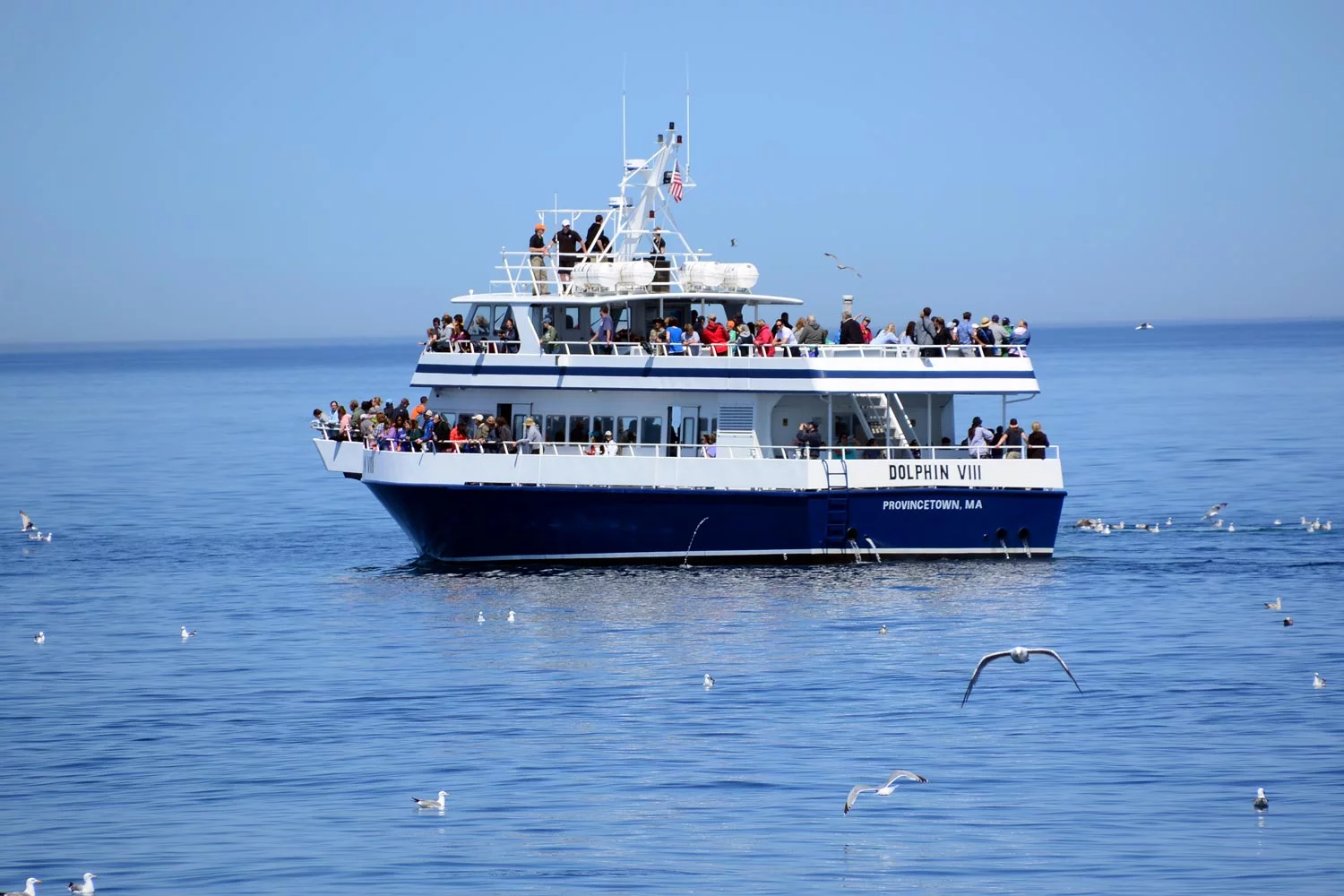
Stellwagen Bank National Marine Sanctuary lies eight miles north of Provincetown, a submerged plateau where nutrient-rich currents support dense concentrations of sand lance and other forage fish. Humpback whales, fin whales, and minke whales feed here from spring through fall, and Provincetown's fleet has documented the same individual humpbacks returning year after year. The sanctuary's research program has cataloged more than nine hundred humpbacks by their unique fluke patterns, and many Provincetown naturalists can identify specific whales by sight. Provincetown whale watching reviews often distinguish between larger commercial vessels carrying two hundred passengers and smaller boats with capacity under one hundred. Larger ships offer multiple viewing decks, indoor seating, and full galleys, while smaller craft provide closer sightlines and more flexible positioning when whales surface nearby. Both categories operate under the same federal approach guidelines, which require vessels to remain at least one hundred yards from whales unless the animal initiates closer contact. Guest reviews frequently note that naturalist quality varies more than vessel type: the best-rated cruises pair experienced interpretation with patient captains who allow whales to dictate the encounter rather than chasing every distant spout. Sighting consistency depends on seasonal prey availability rather than operator skill. Humpback whales arrive at Stellwagen Bank in mid-April as herring and sand lance populations peak, and feeding activity remains strong through late October. July and August see the highest concentrations, with multiple whale groups often visible from a single location. Fin whales, the sanctuary's second most common species, appear more sporadically and tend to move faster, making close observation less predictable. Minke whales are present throughout the season but surface less conspicuously. North Atlantic right whales pass through Stellwagen Bank during spring and fall migrations, though sightings remain rare due to the species' critically endangered status and protected buffer zones. Reviews of Provincetown whale-watching operators also assess onboard amenities and how companies handle weather variability. Massachusetts Bay conditions can shift rapidly, and some guests prioritize vessels with enclosed cabins and stabilization systems over open boats with minimal shelter. Refund and rescheduling policies matter when fog or high seas force cancellations. The most transparent operators communicate sea conditions and recent sighting reports before departure, setting realistic expectations rather than guaranteeing encounters the marine environment may not deliver.
“The sanctuary's research program has cataloged more than nine hundred humpbacks by their unique fluke patterns, and many Provincetown naturalists can identify specific whales by sight.”
The prime window for whale sightings in Stellwagen Bank National Marine Sanctuary extends from mid-April through October, coinciding with the peak feeding season for humpback, finback, and right whales. Whale activity remains consistent throughout these months, though weather conditions and sea states typically favor travel during the summer and early autumn.
Cool, variable 45–60°F. Sightings increase as whales return to feed.
Warm, stable 70–80°F. Peak activity with frequent whale surface behaviors.
Mild, cooling 55–70°F. Excellent whale activity before the seasonal migration south.
—;Morning departures often feature calmer sea conditions for better visibility.
Verdict: For the most consistent sightings and manageable crowds, aim for weekday mornings during the months of June or September.
Vessels departing for Stellwagen Bank National Marine Sanctuary launch from MacMillan Pier in the heart of Provincetown. Visitors generally access the waterfront via Route 6, which spans the length of the Cape.
Route 6 East to Provincetown
Plymouth & Brockton Street Railway to Provincetown Chamber of Commerce
Bay State Cruise Company or Boston Harbor City Cruises from Boston to MacMillan Pier
MacMillan Pier from downtown Provincetown
Parking in Provincetown is limited during the summer months; visitors should utilize municipal lots or arrive early to secure space before walking to the pier. The sanctuary is an open ocean area accessible 24/7 by boat.
Stellwagen Bank National Marine Sanctuary is a vital ecological hub that serves as a critical feeding and nursery ground for numerous marine species. Its unique underwater topography fuels a productive food web that supports a diverse array of life in the Gulf of Maine.
22 marine mammal species
14,000 years of geological history
Nutrient-rich upwelling currents
Critical feeding ground for endangered whales
Nearly 600 documented species
Important seabird stopover location
Year-round home to various seals
Preparation for your time at Stellwagen Bank National Marine Sanctuary ensures a comfortable experience on the open water.
Take non-drowsy motion sickness medication at least one hour before departure rather than after symptoms begin. Focus your eyes on the stable horizon instead of looking down at phones or books.
Ocean temperatures are significantly lower than on land, so bring a windproof jacket even on warm days. Wearing multiple light layers allows you to adjust quickly as wind chill changes throughout the trip.
Opt for rubber-soled, closed-toe shoes to maintain traction on potentially wet or slippery deck surfaces. Avoid sandals or heels, which lack the stability required for moving on a vessel.
Reflection from the water intensifies UV exposure, making sunscreen, polarized sunglasses, and a brimmed hat necessary. Apply sun protection before boarding, as wind can make reapplication difficult during the transit.
Keep all trash and belongings secured to prevent items from blowing overboard into the sanctuary waters. Follow the guidance of the vessel crew regarding where to stand for the best views without obstructing others.
Everything you need to know about provincetown whale watching reviews
Most travelers provide positive provincetown whale watching reviews that highlight the expertise of naturalists and the frequency of humpback sightings. Guests often note the educational value provided during these excursions into the open ocean. Readers of these provincetown whale watching reviews consistently emphasize the importance of bringing layers, as sea temperatures can be lower than on land. Marine conservation remains a central theme in these detailed accounts.
While whale activity occurs throughout the summer, peak viewing times often align with stable sea conditions. It is helpful to check seasonal updates on our best time page to ensure your visit aligns with active migration periods. Please note that the sanctuary is an offshore marine area, so visibility of wildlife depends on natural factors.
Many provincetown whale watching reviews describe encounters with diverse species like humpback, finback, and minke whales. These accounts frequently mention the behavior of the mammals, such as breaching or tail slapping, which provides a unique look at ocean life. Reviewers often suggest bringing a camera with a good zoom lens to capture these sightings from a boat.
There is no entrance fee to visit the sanctuary itself, as it is an offshore marine area. Visitors pay for the boat passage provided by local tour operators, but access to the protected waters is 0 USD. The sanctuary is managed by NOAA and serves as a critical habitat for various species.
Experienced travelers suggest consulting provincetown whale watching reviews to understand the necessity of arriving at the dock well in advance. Since these trips depart from the harbor, verifying your check-in time remains a top priority. Preparing for potential motion sickness by consulting a pharmacist or bringing appropriate remedies is also a common recommendation found in recent feedback.
Families often find these tours to be an engaging way to learn about marine biology and ocean health. Many provincetown whale watching reviews from parents highlight that naturalists onboard are skilled at keeping younger participants interested in the lecture and sightings. Always verify the age requirements and safety policies with your chosen tour operator before finalizing your plans.
Provincetown Whale Watching Tours
Read more Tickets & toursProvincetown Whale Watching Tickets
Read more Tickets & toursProvincetown Whale Watching Cruise
Read more GuideBest Time of Year for Whale Watching in Provincetown
Read more Tickets & toursPrivate Whale Watching in Provincetown
Read more